Savekar guides
The Ultimate Guide to EV Charging: Infrastructure, Management Software, Charging Networks and Business Solutions
Explore the complete EV charging ecosystem, including EV charging infrastructure, CMS and CSMS software, OCPP, OCPI, commercial chargers, fleet management, white-label platforms and international charging networks. Discover business applications and market opportunities across India, Malaysia and South Africa.

The Complete Guide to EV Charging in India: Infrastructure, CMS, CSMS, OCPP, Fleet Management and Business Solutions
1. Understanding the EV Charging Ecosystem in India
Electric vehicle adoption is creating new opportunities for businesses, property owners, fleet operators and charging network providers across India. As electric cars, two-wheelers, three-wheelers, buses and commercial vehicles become more common, the need for reliable EV charging infrastructure and connected charging management software continues to grow.
An EV charging ecosystem involves more than installing a charging station. It includes charging hardware, electrical infrastructure, charging management software, payment systems, network connectivity, monitoring, maintenance and customer access.
Businesses planning to enter the EV charging market need to understand how these components work together. Whether the objective is to install EV chargers at a hotel, manage a housing society charging network, operate highway charging stations or manage a commercial vehicle fleet, the right technology can make charging operations easier to monitor and scale.
This guide explains the major components of EV charging infrastructure, charging management systems, CMS and CSMS software, OCPP and OCPI protocols, commercial charging models and opportunities across Indian markets.
2. What Is EV Charging Management Software?
EV charging management software is the digital platform used to connect, monitor and manage electric vehicle charging stations.
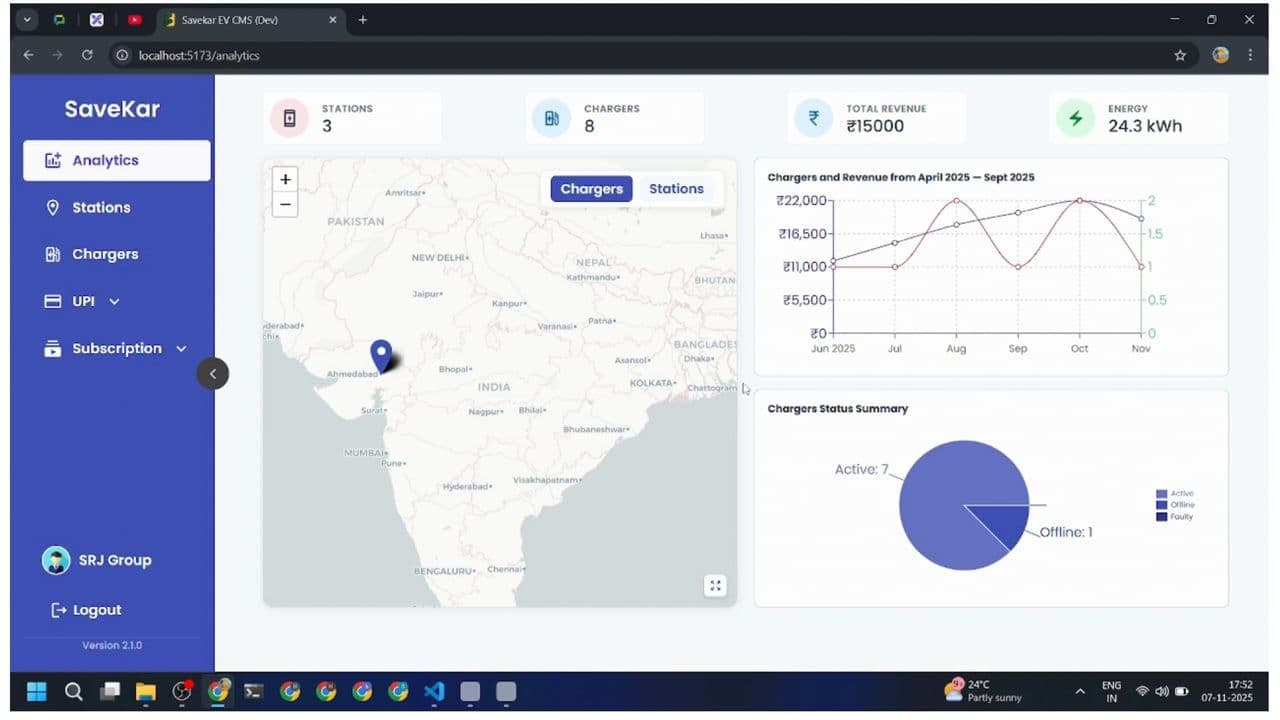
It allows charge point operators, businesses and property owners to monitor charger availability, manage charging sessions, configure tariffs, track revenue and identify technical issues through a centralized system.
EV charging management software is commonly described using terms such as:
- EV Charging Management System
- Charging Management System (CMS)
- Charge Point Management System (CPMS)
- Charging Station Management Software
- Charge Point Management Software
- Charging Network Management Platform
- EV Charger Monitoring Software
- EV Charging Operations Software
- Electric Vehicle Charging Software
Although these terms are sometimes used interchangeably, the exact capabilities can differ between platforms.
A modern charging management platform may provide:
- Live charger monitoring and status updates
- Remote charger management
- Charging session tracking
- Tariff and pricing configuration
- Driver access and user management
- Payment collection and billing
- Revenue reports and analytics
- Fault detection and service alerts
- Multiple-location management
- Network integrations and roaming
For businesses operating several charging points, a centralized EV charging management solution helps reduce manual work and provides better visibility into charging operations.
Explore Savekar's EV Charging CMS to understand how connected charging software can help manage chargers, sessions, pricing and payments.
3. What Is a CSMS? Understanding Charge Point Management Systems
A Charge Point Management System (CSMS) is the software infrastructure that communicates with network-connected EV chargers and manages their operations.
A CSMS connects charging stations to a centralized backend, allowing operators to monitor charger status, receive charging data, configure supported settings and manage charging sessions.
The terms CMS, CSMS and CPMS are frequently used in the EV charging industry. Their precise meaning depends on the product and its intended application.
A CSMS can support several operational functions:
Charger connectivity: Connecting compatible EV chargers to a centralized software platform.
Remote monitoring: Viewing whether charging stations are available, occupied, offline or reporting faults.
Session management: Monitoring charging sessions, energy consumption and transaction records.
Tariff management: Configuring charging prices according to the operator's business model.
User and access management: Managing drivers, fleet vehicles, partners and authorized users.
Reporting and analytics: Reviewing charging activity, usage patterns and revenue.
Network operations: Managing multiple charging locations through one platform.
Businesses that require specific workflows, payment providers, driver applications or third-party integrations may also consider custom CSMS development.
Learn more about Savekar Custom CSMS Development, including configurable platform requirements, APIs, integrations and custom charging workflows.
4. OCPP: The Communication Protocol Behind Connected EV Chargers
Open Charge Point Protocol (OCPP) is a communication standard that allows EV charging stations to communicate with a central management system.
It plays an important role in connected EV charging infrastructure because it helps compatible chargers and backend software exchange operational information.
OCPP can support communication related to:
- Charger status and availability
- Charging session initiation and termination
- Meter values and energy consumption
- Remote commands
- Configuration settings
- Fault notifications
- Transaction information
OCPP 1.6J is widely used in connected charging infrastructure. OCPP 2.0.1 introduces additional capabilities and improvements, but compatibility depends on the charger, firmware and backend implementation.
When selecting an EV charging management platform, businesses should verify the exact OCPP version and features supported by their charging hardware.
An OCPP-compatible backend can also help operators avoid unnecessary dependence on a single charger manufacturer, provided the charger and software support the required functionality.
Read more about Savekar's OCPP-based EV Charging CMS.
5. OCPI and EV Charging Network Roaming
Open Charge Point Interface (OCPI) is a protocol used to exchange information between charging networks and e-mobility service providers.
While OCPP focuses on communication between a charger and its management system, OCPI supports communication and data exchange between different charging networks and service platforms.
OCPI can facilitate:
- Charging station location information
- Connector and availability details
- Charging tariffs
- Charging session information
- CDR and transaction exchange
- Network roaming
- Integration between CPOs and eMSPs
For example, a charge point operator may want its charging stations to be discoverable through another company's EV charging application. OCPI-based integration can help connect the two platforms.
This is particularly useful for charging network operators who want to increase charger visibility and connect with partner networks.
Explore Savekar's OCPI roaming and collaboration solution and its OCPI simulator.
6. Types of EV Chargers and Charging Infrastructure
EV charging infrastructure includes different charger categories based on power output, charging speed, connector type, installation requirements and vehicle compatibility.
AC EV Chargers
AC chargers supply alternating current to the vehicle, where the onboard charger converts it for battery charging.
They are commonly used at:
- Residential properties
- Housing societies
- Hotels and resorts
- Offices and workplaces
- Commercial parking facilities
AC charging is often suitable for vehicles parked for longer periods, such as overnight stays or working hours.
DC Fast Chargers
DC fast chargers supply direct current to the vehicle battery through compatible charging equipment.
They are commonly considered for:
- Highway charging stations
- Fuel stations
- Public charging hubs
- Commercial vehicle depots
- High-traffic locations
- Fleet charging facilities
The appropriate charger capacity depends on vehicle compatibility, electrical supply, expected demand and site requirements.
Common EV Charger Categories
Commercial EV charging infrastructure may include:
- 3.3 kW AC chargers
- 7.4 kW AC chargers
- 11 kW AC chargers
- 22 kW AC chargers
- DC fast chargers
- Higher-capacity DC charging systems
- Dedicated fleet charging equipment
The right charger should be selected after considering vehicle requirements, parking duration, sanctioned electrical load, installation costs and expected utilization.
Explore the Savekar commercial EV charger catalogue to compare available charging hardware and models.
7. Commercial EV Charging Solutions for Businesses
Commercial EV charging is becoming an important consideration for businesses that want to serve electric vehicle users and make better use of their parking infrastructure.
Different businesses have different charging requirements. A hotel may need overnight AC charging, while a highway fuel station may require DC fast charging for travelling vehicles.
A connected charging management system helps businesses monitor their charging infrastructure, manage payments and review usage.
EV Charging for Hotels and Resorts
Hotels and resorts can install EV charging stations to provide an additional facility for guests travelling in electric vehicles.
Charging infrastructure can improve the guest experience while creating an additional service opportunity for the property.
Common requirements include:
- AC charging for overnight guests
- Guest access and payment management
- Charging session monitoring
- Charger availability information
- Revenue tracking
- Fault alerts and maintenance support
Learn more about EV charging solutions for hotels and resorts.
EV Charging for Housing Societies and Residential Communities
Residential societies, apartment complexes and gated communities are important locations for EV charging because residents often park their vehicles for extended periods.
A suitable charging setup should consider electrical load, parking allocation, billing and access control.
Important requirements include:
- Individual resident billing
- Shared electrical load management
- Resident and visitor access
- Charging session records
- Payment collection
- Centralized monitoring
Read the Savekar guide to EV charging for housing societies and communities.
EV Charging for Fuel Stations and Highway Restaurants
Fuel stations, highway restaurants and roadside businesses can consider EV charging infrastructure to serve electric vehicle users travelling between cities.
DC fast charging may be suitable for locations where drivers need to charge during shorter stops. AC charging may also be considered where vehicles remain parked for longer periods.
A commercial highway charging setup may require:
- Suitable parking and charger placement
- Electrical capacity assessment
- Compatible AC or DC charging hardware
- Charging tariffs and payment options
- Remote charger monitoring
- Network visibility and roaming
Explore EV charging for fuel pumps and highway restaurants.
EV Charging for Offices and Workplaces
Office buildings and business parks can provide charging facilities for employees, visitors and company vehicles.
Workplace charging can be designed around employee access, visitor payments, company-sponsored charging and parking duration.
A centralized charging management platform can help businesses manage different charging policies and monitor utilization.
EV Charging for Shopping Malls and Retail Properties
Shopping malls, retail centres and commercial complexes can introduce charging stations in their parking areas.
Drivers can charge their vehicles while shopping, dining or using other facilities.
Charging infrastructure at retail properties may require multiple chargers, parking management, payment integration and real-time charger monitoring.
EV Charging for Commercial Fleets
Companies operating delivery vehicles, taxis, electric three-wheelers, buses and logistics vehicles may require dedicated charging infrastructure.
Fleet charging needs to account for vehicle schedules, depot capacity, energy consumption and charging costs.
Learn more about EV fleet charging management.
8. EV Fleet Charging Management Software
Fleet charging management software helps businesses monitor and manage charging operations for multiple electric vehicles.
It is useful for logistics companies, delivery businesses, taxi operators, corporate fleets, electric bus operators and other organizations transitioning to electric mobility.
A fleet charging management solution can help businesses:
- Monitor charging activity across vehicles
- Track energy consumption
- Associate sessions with drivers and vehicles
- Review charging costs
- Manage depot charging infrastructure
- Monitor charger availability
- Identify charging faults
- Generate operational reports
Fleet operators should also plan charging schedules around vehicle utilization. For example, delivery vehicles may need to be charged between operating shifts, while electric buses may require depot charging during scheduled downtime.
A centralized CSMS can provide better visibility into charging activity across multiple depots and locations.
9. White-Label EV Charging Software
White-label EV charging software allows a business to operate a charging platform under its own brand.
Instead of building an entire EV charging software system from the beginning, a business can use an existing platform and configure supported branding, workflows and operational features.
White-label EV charging platforms may be suitable for:
- EV charging network operators
- Charger manufacturers
- Energy companies
- Franchise operators
- Mobility service providers
- Businesses launching their own charging network
Depending on the platform and selected configuration, white-label capabilities may include:
- Custom branding and domain
- Branded driver experience
- Partner and operator accounts
- Charging station management
- Payment configuration
- Fleet management
- Network integrations
- API connectivity
Explore Savekar White Label EV Charging CMS to understand how businesses can operate charging under their own brand.
10. Custom EV Charging Software and API Integrations
Different EV charging businesses may have different technical and operational requirements.
A charging network operator may need a custom driver application, while another business may require ERP integration, partner dashboards, specialized payment workflows or fleet management features.
Custom EV charging software development can help address these requirements.
Common custom CSMS requirements include:
- Custom operator dashboards
- Driver web portals and mobile applications
- REST API integrations
- Webhooks
- Payment gateway integration
- ERP and accounting connectivity
- Partner and franchise accounts
- Fleet and depot management
- Custom reports and alerts
- OCPP and OCPI integrations
Before selecting a custom platform, businesses should define which capabilities are available immediately and which require additional development.
Learn about custom CSMS development by Savekar.
11. EV Charging Payments, Billing and Revenue Management
Payment management is an important part of commercial EV charging infrastructure.
A charging station operator needs a reliable method to collect payments, maintain transaction records and review charging revenue.
Common payment and billing requirements include:
- Pay-per-session charging
- Per-kWh charging tariffs
- Driver billing
- Fleet billing
- Corporate accounts
- Memberships and subscriptions
- Partner settlement
- Transaction reports
- Refund management
In India, UPI is an important digital payment method for EV charging transactions. Depending on the charging model, drivers may also use supported digital payment gateways and other payment methods.
Businesses should select a payment setup based on their target users, settlement requirements, transaction costs and accounting processes.
Savekar's India-focused charging workflow supports QR-based access, WhatsApp charging and UPI payments. Payment options and settlement arrangements depend on the selected plan and configuration.
For more details, explore Savekar's charging management software and available plans.
12. EV Charger Monitoring, Diagnostics and Maintenance
Charger monitoring is essential for maintaining reliable EV charging operations.
When charging stations are spread across different properties or cities, manually checking every charger becomes difficult.
Connected charging software can provide information about charger availability, charging sessions, faults and operational activity.
Important monitoring capabilities include:
- Real-time charger status
- Charging session monitoring
- Error and fault reporting
- Connectivity monitoring
- Energy consumption records
- Remote diagnostics
- Maintenance alerts
- Service ticket management
AI-powered charger diagnostics can further help operators interpret charger logs, identify unusual patterns and support troubleshooting.
However, AI diagnostics should complement technical inspection and maintenance rather than replace qualified electrical and service personnel.
Explore Savekar AI-powered EV charger diagnostics.
13. Planning an EV Charging Station in India
Setting up an EV charging station requires careful planning before purchasing equipment or starting installation.
The requirements can vary depending on the location, charger capacity, electrical infrastructure and intended business model.
Step 1: Select the Location
Choose a location based on vehicle movement, parking availability, expected charging demand and nearby facilities.
Potential locations include:
- Hotels and resorts
- Housing societies
- Offices and business parks
- Shopping malls
- Fuel stations
- Highway restaurants
- Logistics depots
- Public parking facilities
Step 2: Assess Electrical Infrastructure
Evaluate the existing electrical connection, sanctioned load, transformer capacity, cable requirements and potential need for load upgrades.
A qualified electrical professional should assess the site before installation.
Step 3: Select Suitable Chargers
Choose AC or DC chargers based on the expected vehicle types, charging duration, power availability and site requirements.
Check connector compatibility, charger specifications and OCPP support before selecting equipment.
Step 4: Choose Charging Management Software
A suitable CMS or CSMS should support the required charger communication, monitoring, pricing, billing and operational workflows.
Step 5: Configure Payments and Access
Decide how drivers will access chargers and complete payments. The setup may include QR-based charging, supported digital payments, fleet accounts or partner access.
Step 6: Monitor and Maintain the Network
After installation, monitor charger availability, energy consumption, charging sessions and fault reports.
A centralized charging management platform can help operators manage multiple stations without relying entirely on manual site visits.
For additional guidance, explore the Savekar EV charging resources and guides.
14. EV Charging Opportunities Across Indian States and Cities
India's EV charging market includes opportunities across metropolitan cities, industrial centres, tourism destinations, residential communities, commercial properties and highway corridors.
Charging requirements vary by location. Metropolitan areas may require workplace, residential and public charging, while highways and tourism destinations may require charging facilities for intercity travellers.
The following locations represent important Indian urban and regional markets where EV charging infrastructure and charging management solutions may be relevant. They are geographic examples, not a statement that Savekar currently operates in every location.
North India
North India includes major commercial, residential, industrial and tourism markets.
Relevant states and regions include:
- Delhi
- Haryana
- Punjab
- Rajasthan
- Uttar Pradesh
- Uttarakhand
- Himachal Pradesh
- Jammu and Kashmir
- Ladakh
- Chandigarh
Important cities and markets include Delhi, New Delhi, Gurugram, Faridabad, Noida, Greater Noida, Ghaziabad, Jaipur, Udaipur, Jodhpur, Kota, Ajmer, Bikaner, Chandigarh, Ludhiana, Amritsar, Jalandhar, Patiala, Dehradun, Haridwar, Rishikesh, Shimla, Manali, Lucknow, Kanpur, Agra, Varanasi, Prayagraj, Meerut, Srinagar and Jammu.
Potential applications include residential EV charging, hotel charging, office parking, public charging stations, highway charging and fleet depot infrastructure.
West India
Western India has major business centres, industrial areas, tourism destinations and commercial transport corridors.
Relevant states and regions include:
- Maharashtra
- Gujarat
- Goa
- Rajasthan
Important cities and markets include Mumbai, Navi Mumbai, Thane, Pune, Pimpri-Chinchwad, Nashik, Nagpur, Chhatrapati Sambhajinagar, Kolhapur, Solapur, Ahmedabad, Surat, Vadodara, Rajkot, Gandhinagar, Bhavnagar, Jamnagar, Vapi, Panaji, Margao, Vasco da Gama, Silvassa and Daman.
Potential applications include commercial EV charging, residential charging, hotel and resort charging, retail parking, industrial fleet charging and highway fast-charging stations.
South India
Southern India has major technology hubs, industrial cities, commercial centres and established transport networks.
Relevant states and regions include:
- Karnataka
- Tamil Nadu
- Telangana
- Andhra Pradesh
- Kerala
- Puducherry
Important cities and markets include Bengaluru, Mysuru, Mangaluru, Hubballi, Belagavi, Chennai, Coimbatore, Madurai, Tiruchirappalli, Salem, Tiruppur, Hyderabad, Secunderabad, Warangal, Vijayawada, Visakhapatnam, Guntur, Tirupati, Kochi, Ernakulam, Thiruvananthapuram, Kozhikode, Thrissur, Kannur and Puducherry.
Potential applications include office charging, apartment charging, commercial property charging, electric taxi fleets, logistics depots and highway charging.
East India
Eastern India includes industrial, commercial, port, residential and transport markets.
Relevant states and regions include:
- West Bengal
- Odisha
- Bihar
- Jharkhand
Important cities and markets include Kolkata, Howrah, Durgapur, Asansol, Siliguri, Bhubaneswar, Cuttack, Rourkela, Sambalpur, Patna, Gaya, Muzaffarpur, Bhagalpur, Ranchi, Jamshedpur, Dhanbad and Bokaro.
Potential applications include commercial charging stations, residential charging, industrial fleet charging, office charging and public charging infrastructure.
Northeast India
Northeast India includes growing urban centres, tourism destinations and regional transport corridors.
Relevant states include:
- Assam
- Arunachal Pradesh
- Manipur
- Meghalaya
- Mizoram
- Nagaland
- Tripura
- Sikkim
Important cities and markets include Guwahati, Dibrugarh, Silchar, Jorhat, Itanagar, Naharlagun, Imphal, Shillong, Tura, Aizawl, Kohima, Dimapur, Agartala, Gangtok and Namchi.
Potential applications include hotel charging, tourism-related charging infrastructure, commercial parking and regional fleet charging.
Other Indian Union Territories
EV charging infrastructure can also be relevant in India's Union Territories:
- Andaman and Nicobar Islands
- Chandigarh
- Dadra and Nagar Haveli and Daman and Diu
- Jammu and Kashmir
- Ladakh
- Lakshadweep
- Puducherry
- National Capital Territory of Delhi
The appropriate charging model for each location depends on local demand, electrical infrastructure, vehicle usage and site conditions.
15. Choosing the Right EV Charging Management Solution
Selecting an EV charging management solution requires more than comparing software prices.
Businesses should evaluate the platform based on their operational requirements and long-term expansion plans.
Important factors include:
Charger compatibility: Verify supported OCPP versions, charger models and communication requirements.
Centralized monitoring: Check whether the platform can monitor chargers across multiple locations.
Payments and billing: Review supported payment methods, settlement processes, transaction reporting and billing options.
Fleet management: Determine whether charging sessions can be associated with individual drivers, vehicles and business accounts.
Network integration: Check whether OCPI roaming and third-party integrations are supported.
White-label capabilities: Consider whether custom branding, domains and partner accounts are required.
APIs and customization: Evaluate whether the platform can connect with existing business applications and internal systems.
Maintenance and diagnostics: Check how the platform handles faults, alerts and service requests.
Scalability: Select a solution that can support additional chargers, locations and users as the business grows.
16. How Savekar Supports EV Charging Businesses
Savekar provides EV charging software and related solutions for businesses, property owners, charge point operators and fleet operators.
Its platform and services cover several parts of the EV charging ecosystem.
EV Charging CMS
Savekar provides OCPP-based charging management software for monitoring chargers, managing charging sessions, configuring pricing and tracking operations.
Explore the Savekar EV Charging CMS.
Custom CSMS Development
Businesses with specific technical requirements can explore custom CSMS development, including branding, payment configuration, APIs, webhooks and integrations.
Explore Custom CSMS Development.
White-Label EV Charging
Businesses can explore operating an EV charging platform under their own brand through supported white-label capabilities.
Explore White Label EV Charging.
Charger Catalogue
Businesses planning to purchase or compare charging hardware can explore available AC and DC charging solutions.
Browse the commercial EV charger catalogue.
OCPI Network Integration
Charging network operators and e-mobility service providers can explore OCPI-based integration and roaming capabilities.
Explore OCPI Collaboration.
Fleet Charging Management
Businesses operating electric vehicles can explore fleet charging solutions for company vehicles and depot operations.
Explore EV Fleet Charging Management.
AI Charger Diagnostics
Savekar also provides AI-powered charger diagnostics to help identify faults from charger logs and support maintenance workflows.
Explore AI Charger Diagnostics.
17. Frequently Asked Questions About EV Charging in India
What is EV charging management software?
EV charging management software is a platform used to connect, monitor and manage EV charging stations. It can support charger monitoring, session management, pricing, billing, payments and operational reporting.
What is the difference between CMS, CSMS and CPMS?
CMS means Charging Management System, CSMS means Charge Point Management System and CPMS means Charge Point Management System. These terms are often used for similar software platforms, although individual products may offer different capabilities.
What is OCPP in EV charging?
OCPP is an open communication protocol that allows compatible EV chargers to communicate with a central management system.
What is OCPI in EV charging?
OCPI is a protocol used to exchange charging network information between charge point operators and e-mobility service providers. It supports use cases such as station discovery, tariffs, sessions and roaming.
What is the difference between AC and DC EV chargers?
AC chargers supply alternating current to the vehicle, where it is converted by the onboard charger. DC fast chargers supply direct current to the battery through compatible charging equipment and are generally used where faster charging is required.
Can businesses install EV charging stations in India?
Businesses can explore EV charging installations at suitable commercial properties, subject to electrical feasibility, applicable requirements and site conditions. A professional site assessment is recommended before installation.
Which businesses can benefit from EV charging infrastructure?
Hotels, resorts, housing societies, offices, malls, retail centres, fuel stations, highway restaurants, logistics companies and fleet operators can all evaluate EV charging based on their customer and operational requirements.
What is white-label EV charging software?
White-label EV charging software allows businesses to operate charging services using their own branding and supported platform configurations.
Can one software platform manage multiple EV charging stations?
Yes. A centralized CMS or CSMS can manage multiple compatible chargers and locations, depending on the platform's capabilities and configuration.
Why is fleet charging management important?
Fleet charging management helps businesses monitor vehicle charging activity, energy consumption, charging costs and depot operations.
How can businesses monitor EV charger faults?
Connected charging platforms can receive charger status information and fault reports. Some platforms also provide diagnostic tools, alerts and maintenance workflows.
How can I choose an EV charging management platform?
Businesses should evaluate charger compatibility, OCPP support, monitoring features, payments, billing, fleet management, integrations, scalability and maintenance support before selecting a platform.
Conclusion
The growth of electric mobility is creating new opportunities for EV charging infrastructure across India. From residential communities and commercial properties to highways, hotels and fleet depots, different locations require charging solutions suited to their operational needs.
A reliable EV charging ecosystem combines suitable charging hardware, connected CMS or CSMS software, payment systems, monitoring, network integrations and maintenance processes.
As charging networks expand, centralized EV charging management software can help businesses improve operational visibility, manage charging activity and build scalable charging infrastructure.
Businesses planning to launch or expand EV charging operations should begin with a clear understanding of their location, electrical requirements, charger compatibility and software needs. Choosing the right charging management solution can help create a more organized and scalable EV charging operation.
More guides
View all
How to Set Up Commercial EV Charging in India: Permissions, Meters and Tariffs
A step-by-step guide for offices, malls, hotels and retail sites in India: what approvals you need, how to get an EV power connection and meter, how electricity tariffs work, and how to charge drivers.

EV Fleet Depot Charging Requirements: A Guide for Logistics Operators
Electrifying a logistics or delivery fleet starts at the depot. This guide covers the power, chargers, software and processes a depot needs before the first electric vehicle arrives.
What Is an OCPP Backend and How Does It Work?
An OCPP backend is the server every networked EV charger reports to. This guide explains what it does, how a charger connects to it, how OCPP 1.6J differs from 2.0.1, and what to look for when you choose one.